Copy trading
Also called: CopyTrading, copy-trading, social trading, mirror trading
Definition. Copy trading is a service where a platform automatically places a lead trader's orders in your own separate copy portfolio, sized to the amount you assign. You keep the full profit and loss and usually pay the lead a share of profits.
Stanislav Vovchyk · Updated Nov 8, 2026 · 11 tools have it
In short
- Copies fill at your own price: on Binance Futures, slippage protection covers entries only, never exits.
- Binance leads take 10% by default, up to 30% on private futures portfolios, plus 10% of copiers' fees.
- The FCA and ESMA treat automatic copy trading as portfolio management, even if you set your own amount and stop-loss.
- Since 1 July 2026, EU crypto copy trading needs a MiCA-authorised provider. Grandfathering has ended.
The UK Financial Conduct Authority defines copy trading as investors trading by automatically copying another investor's trades. Crypto exchanges offer it for futures and spot, and CFD and stock brokers such as eToro offer it too. As of November 2026, 12 services in our catalogue offer copy trading. All 12 are crypto exchanges, several pair it with trading bots, and one extends it to gold and forex.
What copy trading is, in one paragraph
Copy trading is a service where the platform automatically places a lead trader's orders in a separate copy portfolio in your account, sized to the amount you assign. You pick a lead, fund the copy portfolio and set a few limits. From then on, every position the lead opens, changes or closes is repeated at your size with no action from you.
Each copy is an order in your own name, so you keep the full profit and loss of your own fill, not the lead's. The lead usually takes a share of your profit, and the platform charges its normal fees and spreads. Thematic baskets the platform builds itself (smart portfolios, CopyPortfolios) are not copy trading, because they don't follow one person's live trades.
How a copy trade actually executes
- The lead publishes a portfolio. It is public or private and has a set profit-share rate. On Binance Futures, a private portfolio's rate is fixed when it is created and can't be changed later.
- You fund a copy portfolio. You choose a sizing mode, leverage, a slippage limit and a copy stop-loss.
- The lead trades. They open, adjust or close a position in their own account.
- The copy engine sizes your order. On Binance Futures, Fixed Amount uses a set amount per trade and Fixed Ratio sizes each trade in proportion to your total investment. eToro copies proportionally: if the lead puts 10% of their realised equity into a trade, your copy puts 10% of its equity in.
- Your order reaches the order book. It can fill at a worse price, fill only partly, or be rejected.
- The engine mirrors exits. It copies the lead's closes and changes to stop-loss or take-profit. If your copy stop-loss triggers, it closes every copied position.
- Settlement. The profit share is paid from your realized profit, and part of your trading fees may go to the lead as commission.
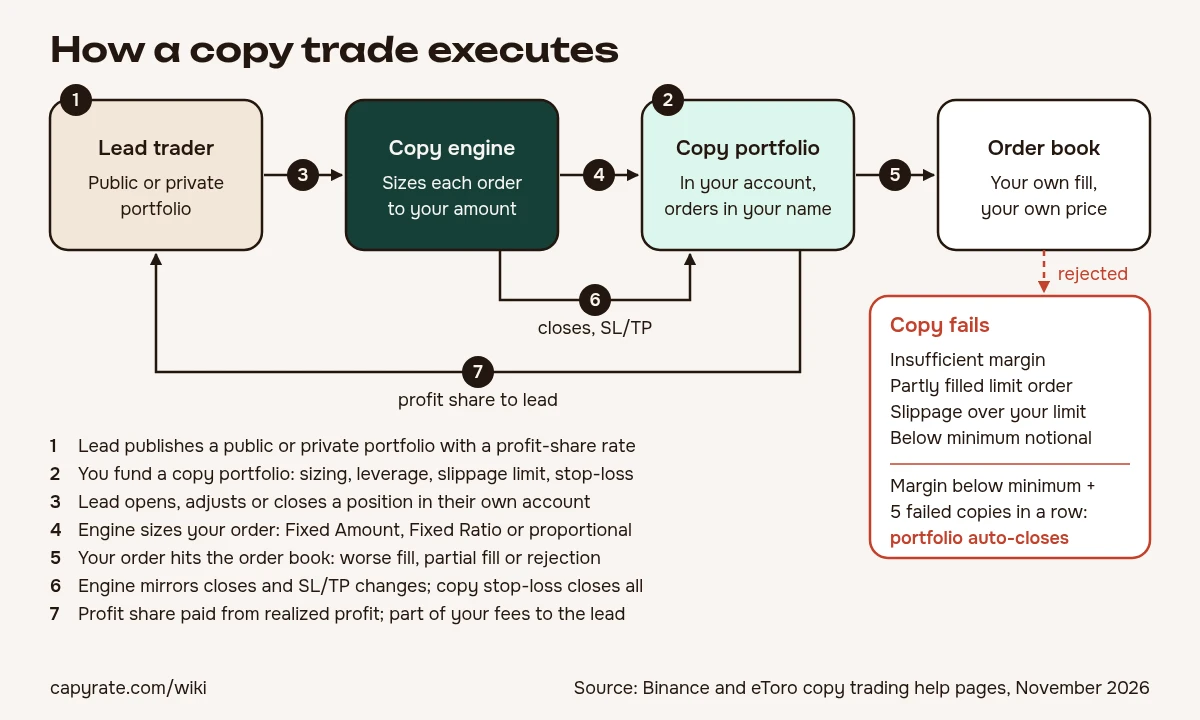 Each copy is your own order: it can fill worse, fill partly or fail, and exits are mirrored but not protected.
Slippage limits. According to the Binance Futures copy trading FAQ, slippage protection defaults to 0.5% for BTCUSDT and ETHUSDT and 1.5% for other pairs. It applies only when a position opens, not when it closes, so a fast exit can fill well away from the lead's price. On Binance Spot, entry slippage is capped at 3%, with defaults of 0.3% for BTC and ETH and 0.5% for other pairs.
Why copies fail. Binance lists four causes: insufficient margin, a limit order that doesn't fully fill, slippage over your limit, and a position below the symbol's minimum notional value. A Binance Futures copy portfolio closes automatically if its margin balance falls below the minimum copy amount and it fails to copy 5 orders in a row. eToro requires each copied position to be at least $1, so on a small copy the lead's smallest trades can fall under that floor.
Copy stop-loss. On eToro, Copy Stop-Loss defaults to 40% of the amount invested and can be set from 5% to 95%. When it triggers, all copied positions close and the remaining funds go back to your balance. Binance Spot has a "Total Stop Loss" that sells all holdings when it is reached.
Stopping or pausing. When you stop a copy on eToro, you choose "Sell All" or "Keep All". Keep All moves the positions into your own portfolio for you to manage. Pausing stops new trades but keeps mirroring closes and SL/TP changes on positions already open.
Account limits (November 2026).
- Binance Futures: 1 public lead portfolio, 1 private lead portfolio and up to 20 copy portfolios per account, across 400+ USDⓈ-M contracts. Sub-accounts can't copy or lead.
- Binance Spot: up to 10 copy portfolios, a minimum balance of 10 or 100 USDT depending on mode, and identity verification with proof of address.
- eToro: $200 minimum and $2,000,000 maximum per copied trader, with up to 100 traders at once.
What it costs: profit share, fees and high-water marks
Profit share. On Binance Futures, lead traders can take up to 30%, and public portfolios default to 10%. On Binance Spot the share is 10%. On both, the lead also earns a 10% commission on the trading fees their copiers pay, which rewards the lead for trading more often.
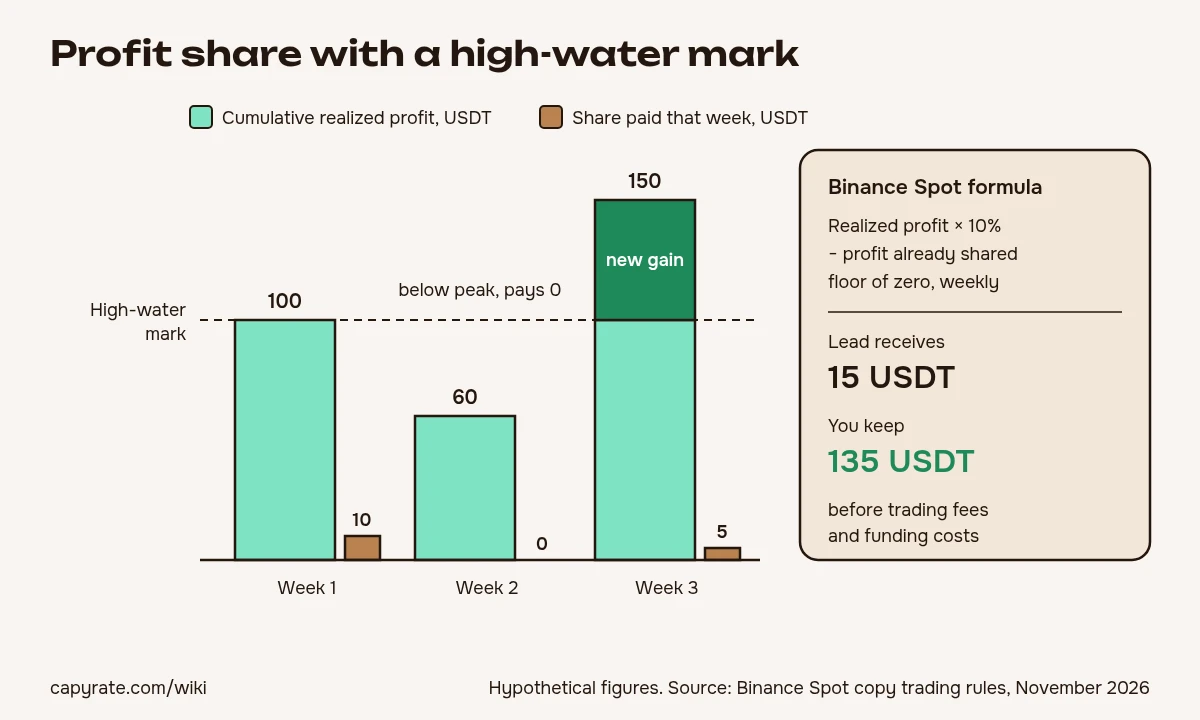 With a high-water mark, the lead's share is charged only on profit above the previous peak.
Settlement. Binance Spot settles weekly, from Monday 00:00 UTC to Sunday 23:59:59 UTC, and pays out only when the copy portfolio has no open orders. The amount is realized profit × share %, minus the profit already shared, with a floor of zero.
High-water mark. A high-water mark means you pay the profit share only on gains above your previous peak, so you don't pay twice for the same profit after a drawdown. The Binance Spot formula works this way. A hypothetical copy at a 10% share:
| Week | Cumulative realized profit | 10% of it | Already shared | Paid this week |
|---|---|---|---|---|
| 1 | 100 USDT | 10 | 0 | 10 |
| 2 | 60 USDT | 6 | 10 | 0 |
| 3 | 150 USDT | 15 | 10 | 5 |
The lead receives 15 USDT and you keep 135 USDT, before trading fees and funding costs. Without a high-water mark, the lead would also be paid on the profit recovered in week 3.
eToro. eToro charges no extra fee for copying a trader, but spreads and transaction fees still apply.
Copy trading vs mirror trading, social trading, signals and bots
| Model | Who decides each trade | Who places the order | UK/EU classification |
|---|---|---|---|
| Copy trading | One lead trader, live | The platform, automatically, in your account | Portfolio management (FCA, ESMA) |
| Mirror trading | A fixed strategy based on your trading preferences, which can involve copying experienced traders | The platform, automatically | Same as copy trading: automatic execution of trade signals |
| Social trading | You, after reading feeds and leaderboards | You | Not portfolio management if you act before each trade |
| Trade signals | The provider suggests, you confirm | You | May be investment advice or reception and transmission of orders |
| Trading bots | Rules you set or pick (grid, DCA) | The bot | For crypto, assessed case by case under ESMA Q&A 2463 |
| PAMM / MAM | A manager under a formal mandate | The manager, in a pooled or allocated account | Managed mandate |
Many platforms use "copy" and "mirror" interchangeably. Some exchanges also let you copy another user's bot settings, which mixes a rule-based bot with a human's choice of parameters. Unlike a PAMM, each exchange copier has a separate sub-portfolio and can usually stop at any time, but regulators can still classify the service as portfolio management.
Risks: why copiers often do worse than the leaderboard
Market and leverage risk. You carry the full market risk. On futures, leverage can empty a copy portfolio quickly, and on Binance the slippage protection does nothing on the exit.
Execution gap. Your entry comes after the lead's, at your own price, and some copies fail outright. A leaderboard return is the lead's result, not their copiers'.
Survivorship bias. Accounts that blew up drop off the rankings, so the track records you can see look better than the average outcome.
Asymmetric incentives. The lead takes part of your gains, pays none of your losses and, on Binance, also earns from your trading fees. That rewards high leverage, high turnover and lottery-like bets.
Behavioural evidence. In a controlled experiment published in Management Science (vol. 66, no. 12, pages 5608 to 5622, December 2020), Apesteguia, Oechssler and Weidenholzer found that information about other traders' success significantly increased risk-taking, and the option to copy them directly increased it further. They conclude that copy trading leads to excessive risk-taking.
Platform and custody risk. eToro's CopyTrader page states that 55% of retail investor accounts lose money trading CFDs with that provider, and that crypto trading isn't covered by MiFID protections such as investor compensation schemes. On a crypto exchange, your copy funds are only as safe as the exchange holding them, and proof of reserves is one partial check.
Scams. The CFTC advisory of 25 January 2024 names very high or guaranteed returns and 100% "win" rates as fraud red flags. Its example is Mirror Trading International, which took about $1.7 billion in bitcoin from at least 23,000 people and turned out to be a Ponzi scheme doing very little actual trading. The CFTC and Australia's ASIC both report fake copy-trading platforms that display made-up profits.
Is copy trading legal and regulated? US, UK, EU
UK. The FCA first published its copy trading guidance on 12 May 2015 and last updated it on 27 July 2026. Where the account holder gives no clear manual input, it classifies copy trading as portfolio or investment management, so a firm offering it with MiFID financial instruments needs portfolio management authorisation. The firm must also carry out suitability assessments, follow conduct of business rules and send periodic reports to clients and the regulator.
Setting your own amount to invest or lose does not change this classification. If you have to act before each trade, the service may instead be investment advice or reception and transmission of orders.
EU. ESMA's 2012 MiFID Q&A (ESMA/2012/382, Question 9) placed the automatic execution of trade signals under the portfolio management definition. ESMA's supervisory briefing ESMA35-42-1428 of 30 March 2023 covered whether copy trading is an investment service, inducements and remuneration, copied traders' qualifications, marketing and cost information, suitability and appropriateness, and product governance.
For crypto, ESMA Q&A 2463, answered on 7 April 2025, notes that MiCA doesn't define copy or auto trading. The MiFID guidance applies by analogy to decide which crypto-asset service a model is, such as portfolio management or advice on crypto-assets. Both need authorisation, and providers must assess each model case by case.
The MiCA transitional period ended across the EU on 1 July 2026, and ESMA required unauthorised providers to have carried out their wind-down plans by then. In late June 2026, Binance told users in France, Italy, Poland and Spain it would restrict or suspend some EU services and stop new EU registrations. It had withdrawn its Greek MiCA application and planned to apply in France instead.
US. I can't point to a CFTC or SEC rule written specifically for copy trading. Copying futures trades for others raises questions about commodity trading advisor registration, and copying securities trades raises questions about investment adviser registration. The CFTC's main public output on the topic is fraud advisories, and it advises researching trade-signal providers before sending money.
How to vet a lead trader and test a copy yourself
- Read the full history, not the headline ROI. Check maximum drawdown, days traded, leverage used, assets under copy, and whether the PnL rests on a few large wins. A short track record or a sudden jump in leverage is a warning sign.
- Start with the minimum. That's $200 on eToro, or 10 to 100 USDT on Binance Spot. To rehearse without money, use a demo account.
- Set the copy stop-loss before funding. Use eToro's Copy Stop-Loss or Binance's Total Stop Loss, at a loss you can accept on the whole copy.
- Compare fills. After a few trades, set your entry prices and sizes against the lead's order history to see your real slippage and any failed copies.
- Calculate the net return. Subtract the profit share, trading fees and funding costs from the gross result, and confirm whether a high-water mark applies.
- Check the exit rules. Find out whether stopping closes everything at market or lets you keep positions, and what happens if the lead deletes their portfolio.
- Check the platform itself. If it reached you through Telegram, WhatsApp or an influencer, check how old its domain registration is and look for it on regulator warning lists.
Choosing a copy trading platform: checklist
- Licence in your country. In the UK, check the FCA Register for a portfolio management or managing investments permission. In the EU, check ESMA's interim MiCA register for an authorised CASP. Grandfathering no longer counts after 1 July 2026.
- Spot or futures. Spot copies can't lose more than the assets bought. Futures copies add leverage and liquidation risk.
- Minimums and caps. Minimum per trader, minimum position size and maximum number of portfolios.
- Profit-share cap and high-water mark. Default and maximum rate, whether the lead can change it, and how often it settles.
- Slippage controls. Whether limits apply only on entry or on exits as well.
- Track-record transparency. Drawdown, leverage, history length and copier count, not just ROI.
- Close-out options. Sell All or Keep All, pause behaviour and auto-closure rules.
- Regional availability. Whether the service is still open to new users where you live after MiCA.
I'd treat any copy as money I could lose in full, and set the copy stop-loss before the first trade rather than after the first drawdown.
Tools that have it
From the directory, based on each tool's own feature list. Check the plan: some offer it only on paid tiers or certain apps.
- B
 BybitOffers trading bots and copy trading · Paid
- O
 OKXWell known copy trading product on exchange · Paid
- M
 MEXCCopy trading and demo trading offered · Paid
- B
 BitMartCopy trading and trading bots offered · Paid
- B
 BingXCopy trading for futures, spot, gold and forex · Paid
- X
 XT.COMCopy trading listed among trading products · Paid
- D
 DeepcoinCopy trading with multiple strategies · See site
- T
 ToobitCopy lead traders or apply as lead trader · Paid
- C
 CoinWCopy trading listed on old site · Paid
- B
 BitgetCopy trading for spot, futures and bots · Paid
- L
 LBankCopy trading offered alongside bots · Paid
FAQ
Is copy trading profitable?
It can be, but nothing guarantees it. eToro states that 55% of its retail CFD accounts lose money, and an experiment published in Management Science found that the option to copy pushes people into excessive risk-taking.
Can you lose more than you invest with copy trading?
On a spot copy, the most you can lose is what you put in. On futures, leverage can wipe out the copy portfolio's margin quickly, and Binance's slippage protection does not apply to exits, so set a copy stop-loss before you fund it.
How much money do I need to start copy trading?
As of November 2026, eToro requires at least $200 per copied trader, and Binance Spot copy portfolios need a minimum of 10 or 100 USDT depending on mode.
Can I copy more than one trader at once?
Yes. eToro allows up to 100 copied traders, Binance Futures up to 20 copy portfolios per account, and Binance Spot up to 10 copy portfolios.
Does setting my own stop-loss mean I'm managing my own money?
Not in the regulator's view. The FCA says that setting parameters such as the amount to invest or lose does not change the classification of copy trading as portfolio management.
Is a trader with a 100% win rate safe to copy?
No. The CFTC lists 100% win rates and guaranteed returns as red flags for fraud, and gives Mirror Trading International, a Ponzi scheme that took about $1.7 billion in bitcoin, as its example.
Cite this page
You are welcome to quote this entry and reuse its pictures with a link to this page.
Vovchyk, S. (2026, November 8). Copy trading. capyrate Wiki. https://capyrate.com/wiki/copy-trading<a href="https://capyrate.com/wiki/copy-trading">Copy trading, capyrate Wiki</a>