Commercial use license
Also called: Commercial license, Commercial usage rights, Commercial rights, Business use license
Definition. A commercial use license is non-exclusive permission from a copyright holder to use a photo, font, song, clip or AI output for profit or promotion, within limits set by the license tier. The creator keeps the copyright.
Stanislav Vovchyk · Updated Nov 13, 2026 · 11 tools have it
In short
- Royalty-free describes how you pay. A commercial license sets what you may do with the file.
- Platform sound libraries (Meta, TikTok, CapCut, YouTube Creator Music) only cover use on that platform.
- Music plans set limits on revenue, channels and client work, e.g. Epidemic Pro excludes companies over USD 10M.
- AI vendors can allow commercial use, but US copyright still requires human authorship.
A commercial use license is permission from a copyright holder to use an asset, such as a photo, font, song, video clip or AI output, for profit or promotion. The creator keeps the copyright. Any use outside the license terms is still infringement, even if you paid.
What a commercial use license is (and what counts as commercial)
A commercial use license is a non-exclusive grant that covers paid ads, branded or sponsored posts, monetized channels, client work, products for sale, and company websites and marketing. Creative Commons 4.0 defines NonCommercial use as use "not primarily intended for or directed towards commercial advantage or monetary compensation". Under that test, a monetized YouTube channel and a brand's Instagram post are both commercial.
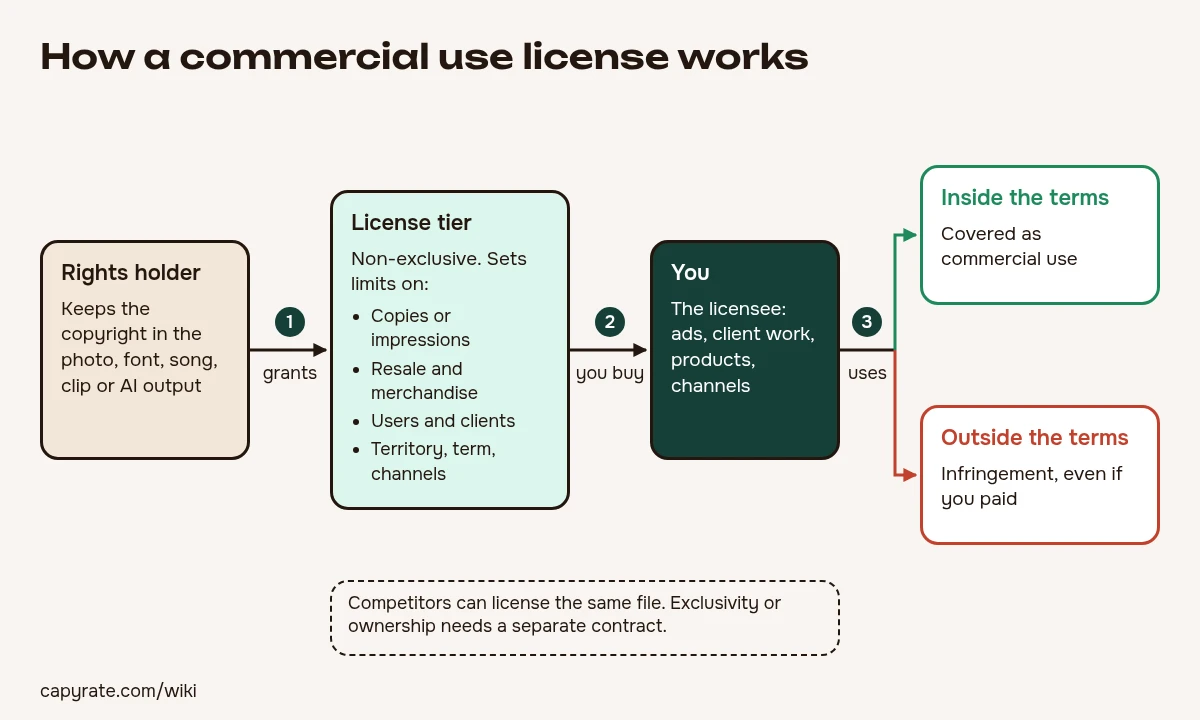 Paying buys a list of permitted uses, not the copyright; anything outside the tier still infringes.
Vendors draw their own lines inside that category. Epidemic Sound's Creator plan allows sponsored or branded content on your own channels. It does not allow digital advertising, marketing or promotion for a brand or company, which needs Pro or higher. In practice, "commercial" in a license means a list of permitted uses, not a simple yes or no.
Stock and library licenses are non-exclusive, so a competitor can license the same file. Getting exclusivity or ownership of the copyright takes a separate contract with the rights holder.
How license tiers work: standard vs extended, editorial, personal vs business
Every tier sets limits in the same few areas:
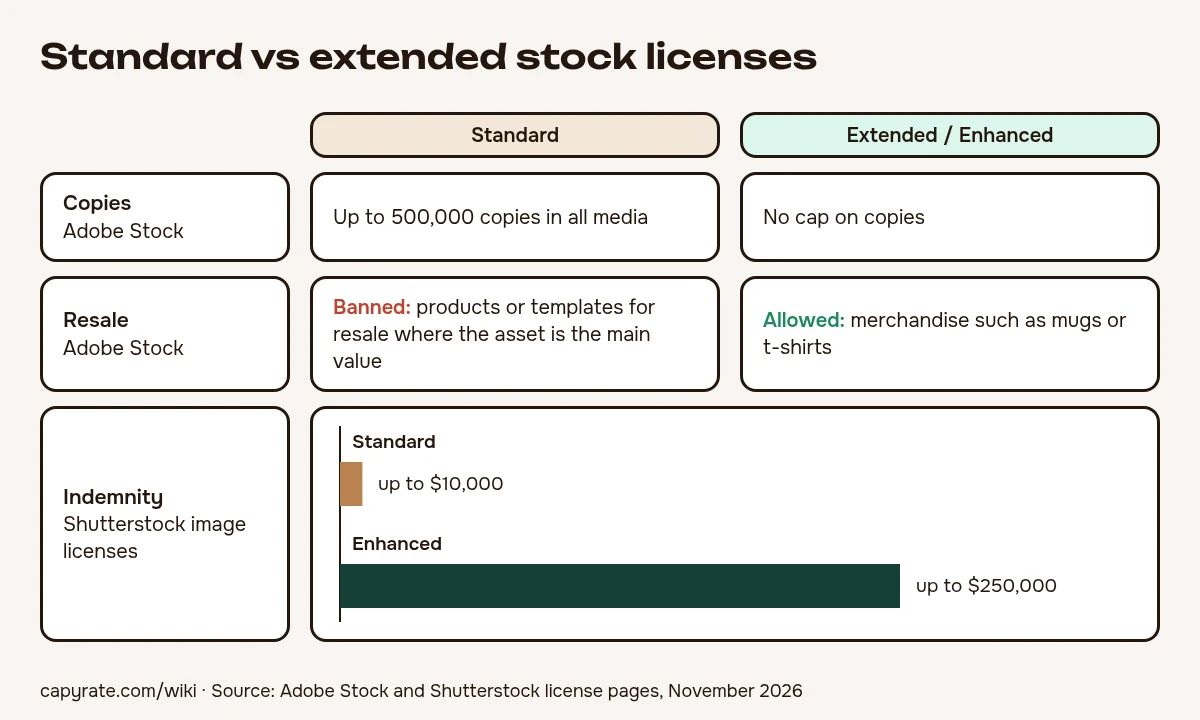 Extended and Enhanced tiers lift caps on copies, merchandise and indemnity; they are not a new kind of use.
- Copies or impressions. The Adobe Stock Standard License allows up to 500,000 copies in all media. Extended removes the cap.
- Resale. Adobe Standard bans products or templates for resale where the asset is the main value. Extended allows merchandise such as mugs or t-shirts.
- Users and transfer. Under Adobe Standard, you may share the unmodified file with employees and contractors who accept the terms, and transfer it to one client or employer. Each additional client needs its own license.
- Indemnity. Shutterstock lists indemnification of up to $10,000 on Standard image licenses and up to $250,000 on Enhanced. Enhanced also adds merchandise, web templates and decoration in commercial spaces.
- Territory, term, channels and seats. These matter most on music subscriptions (see below).
An extended or enhanced license is a standard commercial license with some caps removed. It is not a separate kind of commercial use.
Editorial use only licenses cover news, commentary and education. They exclude advertising, merchandise and promotion, usually because the image has no model or property release or shows trademarks.
Free licenses also allow commercial use, with limits. Unsplash grants an irrevocable, nonexclusive, worldwide license, but you may not sell its images without significant modification or compile them into a similar or competing service. Pexels needs no credit. It bans:
- selling unaltered copies as posters, prints or physical products
- using images in trademarks or business names
- implying endorsement
- showing identifiable people in a bad light
- redistributing the images on other stock or wallpaper sites
Commercial use license vs royalty-free, public domain and Creative Commons
| Term | What it describes | Commercial use? | Main catch |
|---|---|---|---|
| Commercial use license | Scope of permitted uses | Yes, within the tier | Caps on copies, resale, clients, channels |
| Royalty-free | Payment model: one fee or a subscription, no per-use royalties | Not implied | Can still be personal-only, editorial-only, platform-only or capped |
| Public domain | No copyright owner | Yes, no license needed | Trademarks and likeness rights can still apply |
| CC BY 4.0 | Open license | Yes | Attribution required |
| CC BY-NC 4.0 | Open license | No | Bars anything aimed at commercial advantage or payment |
| Editorial only | Scope limited to news, commentary, education | No | Usually no model or property release |
| Platform-only commercial (Meta Sound Collection, TikTok CML, CapCut Commercial sounds, YouTube Creator Music) | Scope tied to one platform | Yes, on that platform | Coverage ends once you post elsewhere |
| Exclusive license or assignment | Separate contract | Yes | Not offered by default on stock libraries |
Fonts and icons: desktop, web, app and logo rights
Most Google Fonts use the SIL Open Font License 1.1, dated 26 February 2007. You may use these fonts commercially, including in logos, packaging and client work. You may also bundle, redistribute and sell them with any software. You may not sell the font file by itself, and modified versions may not use a Reserved Font Name without permission.
Adobe Fonts are licensed for personal and commercial use with a Creative Cloud subscription, including client print work and video. Embedding a font in an app, installing it on a server and sharing the font files each need a separate license from the foundry.
A font can carry separate rights for desktop use (artwork, print), webfont use and app or ePub embedding. "Free" fonts outside the OFL may be personal-use only. Don't send font files to clients or printers unless the license allows it. Icon sets work the same way: CC BY icons need credit, and CC BY-NC icons cannot go into commercial work.
Music and sound in commercial videos: ads, branded Reels and TikToks, YouTube monetization, client work
Instagram and Facebook. Meta's Music Guidelines say "use of music for commercial or non-personal purposes in particular is prohibited" unless you hold the licenses. Access to Instagram's Licensed Music Library depends on account type and country. Accounts without access can use Sound Collection instead. The Sound Collection Terms (last modified March 16, 2022) license that audio for commercial or non-commercial use only in content on Meta products, and forbid using it separately.
TikTok. TikTok's general music library is not for business commercial use. Its Commercial Music Library is a pre-cleared global library of 1 million songs, free for businesses, that covers organic posts, video ads and branded content. TikTok advises businesses to check with their legal team before using another user's original sound.
CapCut. CapCut's Materials License Agreement (updated July 25, 2023) treats Commercial sounds as Dual Use Materials, which may only be distributed on CapCut, TikTok and TikTok for Business. If a project mixes Dual Use and non-commercial materials, the whole video is restricted to personal, non-commercial use.
YouTube. Audio Library tracks won't be claimed through Content ID, and Partner Program creators can use them in monetized videos. Creative Commons tracks need the artist credited in the description. YouTube Creator Music sells per-video licenses or revenue sharing for mainstream tracks. Those tracks can only be used in videos uploaded to YouTube, not in live streams, and Creator Music is only available to Partner Program creators in the U.S.
Subscription libraries.
- Epidemic Sound Pro: monetize 3 channels per platform, sublicense music for freelance client work, and run online digital ads only. Cinema, TV shows and TV ads are excluded. Publishers with yearly revenue over USD 5 million and companies over USD 10 million cannot use Pro.
- Epidemic Sound Business: adds up to 3 collaborator accounts, music in games, apps and company events, and influencer licensing up to 10 times a month. It is for companies with yearly turnover up to USD 25 million. Larger companies need Enterprise.
- Musicbed Individual and Business: cover social accounts with up to 1M followers. Business also covers work for clients with up to 250 employees. Broadcast, cinema, VOD/OTT/CTV, games and accounts over 1M followers need Enterprise. None of the plans has a public price.
- Artlist Social (personal): $14.99 a month billed monthly, or $9.99 a month billed yearly. Third-party guides report that it excludes client work and paid ads.
Our catalogue lists 11 services that offer commercial licensing, and 2 of them have a free plan or free version. Among the 8 that publish prices, the cheapest paid plan is $6.99/mo and the median starting price is $16.5/mo. Entry-level plans are usually personal tiers, so check the rules on ads and client work before choosing on price.
After you cancel. Epidemic Sound says content published on safelisted channels during an active subscription or trial stays cleared. Content published after the subscription ends is not cleared, even if you downloaded the track earlier. I'd safelist every channel before the first upload rather than after the first claim arrives.
Commercial rights for AI-generated images, music and video
Permission from an AI vendor to use an output commercially is not the same as copyright. In its Part 2 report of January 29, 2025, the US Copyright Office concluded that AI outputs are protected only where a human author has determined enough of the expressive elements. Prompts alone do not qualify, but human arrangement or modification of outputs can. In February 2023 the Office narrowed the "Zarya of the Dawn" registration to the text and arrangement, excluding the Midjourney images.
In Thaler v. Perlmutter, the D.C. Circuit upheld the human-authorship requirement on March 18, 2025, and denied rehearing on May 12, 2025. The Supreme Court denied review on March 2, 2026. As a result, if you sell an output created from prompts alone, others may be free to copy it.
What the vendors' terms grant:
- Midjourney (terms effective May 27, 2026): you own your Assets to the extent the law allows. A company with over USD 1,000,000 a year in revenue, or an employee of one, must be on Pro ($60/month) or Mega ($120/month) to own its Assets.
- Suno (terms revised Aug 10, 2026, effective Sep 3, 2026): outputs from the free Basic tier are for personal, non-commercial use only. Pro and Premier subscribers are assigned Suno's rights in outputs, but may only use commercially the outputs they download within their tier's monthly allotment. Suno does not promise that any copyright exists in an output.
- Adobe Firefly: under Adobe's partner-model terms (effective May 8, 2026), features powered by models Adobe did not train are excluded from Firefly IP indemnification. A supplemental tier covers Google and OpenAI image and video models only on eligible licenses, and excludes anything labelled beta, trial or preview.
- OpenAI: its March 2023 Terms assign to the user all of OpenAI's right, title and interest in Output, provided you comply with the terms.
On any plan, other users can generate near-identical images, so you get no exclusivity. An output that resembles a protected character or trademark can still infringe.
Risks and limits: claims, takedowns, indemnity gaps
- Content ID claims. Platforms compare uploads against reference files. An unlicensed match can lead to a claim, muted audio, a blocked video or ad revenue going to the rights holder. Libraries can release claims on safelisted channels covered by an active license.
- Cross-posting. A Reel made with Sound Collection audio is no longer covered once you re-upload it to your website or YouTube.
- Size thresholds. A growing business can cross Midjourney's or Epidemic Sound's revenue limits and need a higher tier.
- Client transfer. Adobe Standard transfers to one client. Personal music plans may exclude client channels entirely.
- Indemnity gaps. Indemnity has caps ($10,000 vs $250,000 at Shutterstock) and exclusions (beta and third-party models in Firefly).
- Changing terms. Suno's 2026 terms changed when outputs may be used commercially. Keep a dated copy of the license that applied when you downloaded each file.
How to check your license and choose a service
- Open the asset's license page, not its download page, and save it as a dated PDF or screenshot.
- Check your account history for the tier attached to the download (Standard vs Extended or Enhanced). Look for an "Editorial use only" label before using the file in ads.
- Compare your planned use against the caps: copies or impressions, merchandise or templates for resale, seats and client transfer.
- Find out where every music track came from. In-app libraries cover only their own platform.
- As a business on TikTok, add sounds from the Commercial Sounds tab. On CapCut, check that every sound in the project carries the commercial label.
- On music subscriptions, safelist every channel before you upload. Confirm whether your plan covers client channels, paid ads and broadcast.
- Check company-size limits: Epidemic Pro's USD 5M and 10M cutoffs, Midjourney's USD 1M rule, and Musicbed Business's limit of clients with up to 250 employees.
- For fonts, read OFL.txt or the foundry's EULA, and confirm desktop, webfont and app-embedding rights.
- For AI outputs, record which plan you were on when you generated or downloaded the file, whether the model was beta or third-party, and what human edits you made.
- Run a reverse image search on "free" stock images. If an image shows people, logos or private buildings, check for model or property releases.
When comparing services, look at scope, price per seat, indemnity amount, company-size limits, and whether the full terms are public before you pay.
Tools that have it
From the directory, based on each tool's own feature list. Check the plan: some offer it only on paid tiers or certain apps.
- S
 ShutterstockStandard license for creative and digital use · From $25/mo
- A
 Adobe StockLicensed assets with indemnification up to $10,000 · From $29.99/mo
- E
Epidemic SoundDirect global license with channel clearing · From $17.99/mo
- E
 EnvatoCommercial license covers client work · From $16.50/mo
- U
 UnsplashUnsplash+ library licensed for commercial use · Freemium
- G
 Getty ImagesCreative licenses and rights-managed pricing · Paid
- S
 SoundstripeSubscription or single-song licensing · From $9.99/mo
- M
 MusicbedMusic licensing with custom rights clearances · Paid
- P
 PremiumBeatPremium license for commercial distribution · From $24.99/mo
- U
 UppbeatLicenses for client work and businesses · Free, from $6.99/mo
- P
 Pond5Individual License with indemnification · From $10/mo
FAQ
Does a monetized YouTube channel count as commercial use?
Yes. Under the Creative Commons test, anything mainly aimed at commercial advantage or money is commercial, and ad revenue meets that test. YouTube's Audio Library tracks can be used in monetized videos by Partner Program creators.
Can I use TikTok or CapCut commercial sounds on YouTube or Instagram?
No. CapCut limits music in its Commercial sounds to CapCut, TikTok and TikTok for Business, and TikTok's Commercial Music Library is built for TikTok content. Posting the video elsewhere needs a separate license.
Can I keep using stock music after I cancel my subscription?
On Epidemic Sound, content you published on safelisted channels while subscribed stays cleared. Anything you publish after cancelling is not cleared, even if you downloaded the track earlier.
Can I use a Google Font in a logo or a product I sell?
Yes, if the font uses SIL OFL 1.1, which allows commercial use and bundling with software you sell. You cannot sell the font file on its own.
Can I sell Unsplash or Pexels photos as prints?
Not as they are. Unsplash bans selling images without significant modification, and Pexels bans selling unaltered copies as posters, prints or physical products.
Can I sell AI-generated images or music?
Only if your plan allows it. For example, Suno's free Basic tier is non-commercial, and Midjourney requires Pro or Mega for companies with over USD 1M in yearly revenue. In the US, outputs created from prompts alone may not be protected by copyright.
Cite this page
You are welcome to quote this entry and reuse its pictures with a link to this page.
Vovchyk, S. (2026, November 13). Commercial use license. capyrate Wiki. https://capyrate.com/wiki/commercial-use-license<a href="https://capyrate.com/wiki/commercial-use-license">Commercial use license, capyrate Wiki</a>