Royalty-free
Also called: RF, royalty free license, royalty-free license, royalty-free music
Definition. Royalty-free is a licensing model: you pay a one-time fee or a subscription, then reuse a copyrighted asset without per-use fees, within the licence's terms. It is neither free of charge nor free of copyright.
Stanislav Vovchyk · Updated Nov 13, 2026 · 11 tools have it
In short
- Royalty-free describes how you pay, not the price. The asset stays copyrighted and the licence terms still apply.
- PRO-registered tracks can still earn performance royalties, usually paid by the broadcaster or venue.
- Subscription libraries usually cover only content published or registered while your subscription is active.
- A valid licence does not stop YouTube Content ID claims. It is your grounds to dispute them.
Royalty-free is a way of licensing creative work such as music, photos, video and sound effects. You pay once or subscribe, then reuse the asset without paying for each use, view or copy. It does not make the asset free of charge or free of copyright, and that is where most of the confusion about the term starts.
What royalty-free means
Royalty-free means you pay a one-time fee per asset, or a subscription, and can then reuse the asset across projects with no usage-based fees, as long as you follow the licence terms. The work stays under copyright: the owner keeps the rights and you get a non-exclusive licence with conditions.
US law gives a copyright owner six exclusive rights: reproduction, derivative works, distribution, public performance, public display and, for sound recordings, digital audio transmission. A royalty-free licence grants you only some of these, under conditions. Copyright exists from the moment a work is created and fixed in tangible form. Registration is voluntary, so a missing © notice does not mean a work is unprotected.
Three typical cases:
- Music: you license a track once and use it in several videos on your channel, within the licence's media and audience limits.
- Photo: you license a stock image for a website, a brochure and social posts, up to the licence's copy cap.
- Sound effect: you download an effect from a subscription library and use it in a podcast and a game trailer, provided each project is covered.
Because the licences are non-exclusive, the same track or photo can be licensed to your competitors. Exclusivity or a full buyout costs extra and is negotiated separately.
How a royalty-free licence works, step by step
- Creator → library. A composer or photographer uploads the asset and gives the library the right to sublicense it, either non-exclusively or exclusively. The creator keeps the copyright or assigns it to the library.
- You → library. You pay per asset or by subscription and accept the terms: scope, caps and banned uses.
- Library → you. The library grants a non-exclusive licence to reuse the asset without per-use fees. You often get a licence certificate or are asked to register the project.
- You → platform. You publish. An automated system such as YouTube Content ID may match the track and place a claim.
- Library → platform. The library safelists your channel or releases the claim when you show the licence.
- Broadcaster or venue → PRO. If the music is registered with a performing rights organisation and is broadcast or played in public, the broadcaster or venue pays performance royalties under a blanket licence, based on the cue sheets you file.
- PRO → creator. The PRO passes the performance royalties to the composer and publisher. You owe the library nothing more.
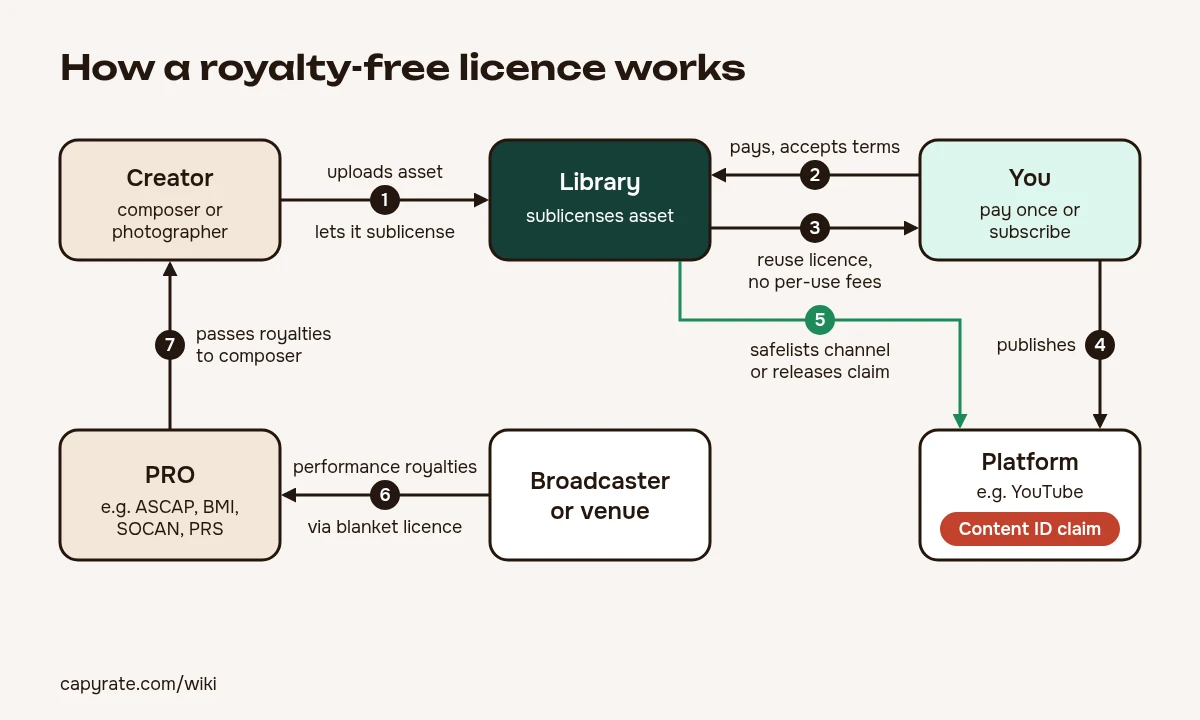 You pay the library once. Performance royalties, if any, go from broadcaster to PRO to composer.
Each vendor sets its own licence term, and the subscription vendors have tightened theirs:
- Adobe Stock describes its visual asset licence as perpetual and worldwide.
- Epidemic Sound: content published during an active subscription stays cleared forever, provided your channels were safelisted (connected to the account). Content published after the subscription ends is not covered.
- Envato Elements (official info page updated 14 August 2026): the commercial licence lasts for life after cancellation, but each licence is tied to one registered project. New projects need an active subscription. Certificates can be downloaded from "My Downloads".
- Artlist: assets must be published or broadcast while the subscription is active. They stay covered in the same media after cancellation, and its 2026 licence PDFs limit new projects to the paid term.
Royalty-free vs copyright-free, public domain, Creative Commons and rights-managed
| Model | Still under copyright? | Typical cost | Attribution | Commercial use | Reuse |
|---|---|---|---|---|---|
| Royalty-free | Yes | One-time fee or subscription | Usually not required | Yes, within caps and bans | Many uses for one fee, non-exclusive |
| Rights-managed | Yes | Priced per use (medium, territory, duration, audience) | Per contract | Only the use you paid for | Each new use needs a new fee |
| Public domain | No (expired or never applied) | Free | Not required | Yes | Unlimited, no licence needed |
| CC0 | Rights waived as far as the law allows | Free | Not required | Yes | Unlimited |
| CC BY | Yes | Usually free | Required: credit, licence link, note of changes | Yes | Unlimited if you follow the terms |
| CC BY-NC | Yes | Usually free | Required | No | Non-commercial only |
| "Copyright-free" | Marketing term | Varies | Varies | Only safe if it really means public domain or CC0 | Varies |
CC0 waives copyright and related rights worldwide to the extent the law allows. It does not waive patent, trademark, publicity or privacy rights, so a CC0 photo of a recognisable person or a logo can still cause problems. Under CC BY 4.0, the licensor cannot revoke your freedoms as long as you follow the terms.
Music carries two separate copyrights: one in the composition and one in the sound recording. A public-domain composition, such as an old classical piece, can be recorded today, and that recording has its own copyright. For US works created on or after 1 January 1978, the usual term is the author's life plus 70 years. Anonymous, pseudonymous and work-for-hire works get 95 years from publication or 120 from creation, whichever ends first.
Old recordings are protected for longer than many people expect. In the US, the Music Modernization Act of 2018 gives pre-1972 sound recordings federal remedies for 95 years after first publication plus a transition period. Pre-1923 recordings lost protection on 31 December 2021. Recordings from 1923 to 1946 get 5 more years and those from 1947 to 1956 get 15 more, while all other recordings fixed before 15 February 1972 stay protected until 15 February 2067.
Royalty-free music and performance royalties (PROs, cue sheets, venues)
"Royalty-free" refers to the sync licence, which lets you put the music into your video. It says nothing about public-performance royalties. If a track is registered with a PRO (ASCAP, BMI, SOCAN, PRS), performance royalties can still arise when the finished work is broadcast or played in public.
PremiumBeat says most of its tracks are PRO-affiliated and that performance fees may apply to broadcast, VOD/OTT and film uses. These are usually paid through a blanket licence by the exhibitor, such as a network or streaming platform, not by the creator. Some catalogues avoid PROs altogether. Epidemic Sound says it owns all economic rights to its catalogue, so subscribers don't pay separate PRO royalties for public broadcasts.
For TV, radio and film, the production company files a cue sheet listing each PRO track with its composer and publisher. Pond5 says video games are not treated as a performance and that filing a cue sheet costs nothing extra.
Playing music in a shop, restaurant or event is a separate public-performance question. In the UK, PPL PRS says that if your business uses, plays or performs music, you probably need TheMusicLicence. In the US, the equivalent licences come from ASCAP and BMI. The alternative is a library whose terms explicitly cover public performance.
Limits and risks hidden in royalty-free licences
The Adobe Stock licence terms show the typical structure:
- Copy and audience caps: the Standard licence allows up to 500,000 copies in all media. Email, ads and broadcast are allowed only if the expected audience is under 500,000. Web and social use has no view limit.
- Resale: Standard bans merchandise where the asset is the main value. The Extended licence removes the 500,000 cap and allows products for resale such as mugs and t-shirts.
- Stand-alone redistribution: neither Standard nor Extended lets you distribute the file on its own.
- Client transfer: a licence can't pass to more than one employer or client unless you license it separately for each.
Shutterstock's Standard licence also limits print runs to 500,000 copies, and larger runs need its Enhanced licence. Its comparison page lists legal indemnification of up to $10,000 per image under Standard and up to $250,000 under Enhanced. Indemnification is the amount the vendor will cover if a third party claims the asset infringes their rights.
Other clauses to look for are bans on sensitive subjects, on use in logos or trademarks, and on AI training. For music subscriptions, the cancellation rules above are the biggest hidden limit.
Using an asset outside your licence is infringement. Under 17 U.S.C. 504(c), US statutory damages run from $750 to $30,000 per work. They can rise to $150,000 for wilful infringement or fall to $200 for innocent infringement.
YouTube Content ID claims on licensed tracks
Content ID scans every YouTube upload against audio and visual reference files submitted by rights owners. A match creates a claim that can block the video, monetize it for the claimant or track it, and the outcome can differ by country. Only owners with exclusive rights to a substantial body of frequently uploaded material get access, and repeated erroneous claimants can lose it. A valid licence does not stop the automated match.
"Content ID-safe" means the library safelists your channel or releases claims on request. That is a service feature, not a legal status, so connect your channel to the library before publishing. YouTube's own Audio Library offers royalty-free music and sound effects that won't be claimed through Content ID. Its Creative Commons tracks still require credit in the video description.
YouTube's dispute rules accept holding a licence as a valid reason. Giving credit, owning a copy or not monetizing are not valid reasons. The claimant has 30 days to release the claim, reinstate it, request removal or let it expire.
If you appeal a reinstated claim, the claimant has 7 days to respond. Envato says its licence certificates can be used to resolve Content ID claims.
How to check a royalty-free licence yourself
- Open the actual licence agreement, not the marketing page. Note its version date and save a PDF with your download date. I'd file it next to the project, because vendors revise these terms.
- Check whether the licence is perpetual and what happens when you cancel: whether it covers only content published during the subscription, and only on safelisted channels or registered projects.
- Look for numeric caps (copies, audience size, production budget), banned uses (resale merchandise, stand-alone redistribution, sensitive subjects, logos and trademarks, AI training) and the indemnity amount.
- For music, check whether the track is PRO-registered. If the project will be broadcast, streamed on TV or VOD, or shown in cinemas, file a cue sheet with the composer and publisher details.
- Before publishing on YouTube, connect or safelist your channel. After upload, check YouTube Studio > Content > Copyright and dispute any claim with "license" and your certificate.
- For "free" tracks, identify the exact Creative Commons licence (BY, BY-NC, CC0) and give credit in the format it requires.
- For in-store or venue playback, confirm whether you need a separate public-performance licence or a library that covers public performance.
Choosing a royalty-free music, SFX or stock service
As of November 2026, our catalogue lists 11 services offering royalty-free licensing, and 2 of them have a free plan or free version. Of the 7 with a published price, the cheapest paid plan is $6.99/month and the median starting price is $10/month. As one example of tiered pricing, Envato Elements listed Core from $16.50/month, Plus from $39/month and Ultimate from $109/month, billed annually, as of 24 February 2026.
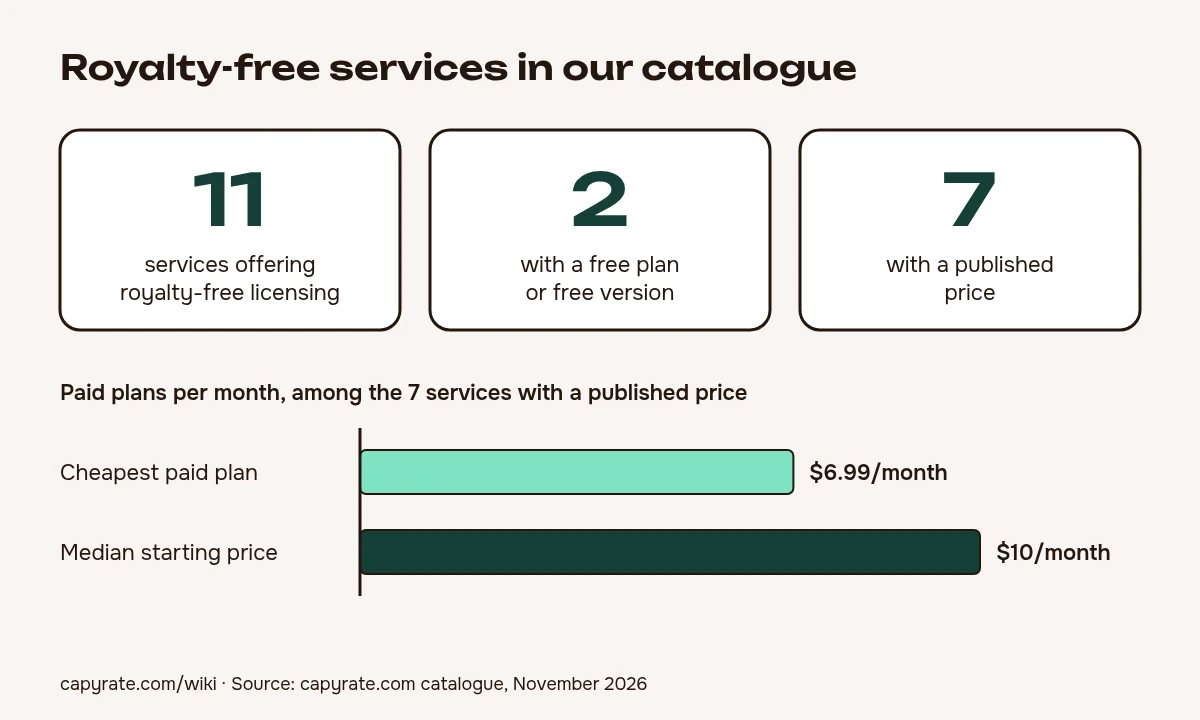 Our catalogue in November 2026: the cheapest paid plan is $6.99 and the median start is $10 a month.
- Per-track or subscription: per-asset licences such as Adobe Stock's are described as perpetual. Subscriptions tie coverage to what you publish or register while you're paying.
- Broadcast and ads tiers: basic tiers often stop short of broadcast, large ad campaigns or 500,000 copies.
- PRO status: a PRO-free or fully owned catalogue avoids cue-sheet work and performance-royalty questions.
- Content ID handling: look for channel safelisting or claim clearing, and check how many channels are included.
- Indemnity: the gap between $10,000 and $250,000 matters if a claim against a client would be costly.
- Clients: check whether one licence covers client work or each client needs its own.
- AI terms: newer licences add rules on AI-generated content and AI training.
Tools that have it
From the directory, based on each tool's own feature list. Check the plan: some offer it only on paid tiers or certain apps.
- S
 ShutterstockRoyalty-free images, video and music · From $25/mo
- A
 Adobe StockLicensed stock with indemnification up to $10,000 · From $29.99/mo
- E
Epidemic SoundDirect license with channel claim clearing · From $17.99/mo
- A
 ArtlistRoyalty-free music, SFX and footage subscription · From $9.99/mo
- E
 EnvatoUnlimited downloads under one commercial license · From $16.50/mo
- U
 UnsplashFree photos plus paid Unsplash+ licensing · Freemium
- S
 SoundstripeSubscription or single-song royalty-free licensing · From $9.99/mo
- M
 MusicbedCurated music licensing with SyncID claim clearing · Paid
- P
 PremiumBeatPer-track Standard and Premium licenses · From $24.99/mo
- U
 UppbeatRoyalty-free music with YouTube safelisting · Free, from $6.99/mo
- P
 Pond5Per-asset or subscription royalty-free licensing · From $10/mo
FAQ
Can I put royalty-free images on t-shirts or mugs I sell?
Usually not on a standard licence. Adobe Stock's Standard licence bans merchandise where the asset is the main value, and its Extended licence allows products for resale.
Do I need to credit royalty-free music or images?
Commercial royalty-free licences usually don't require attribution. Creative Commons BY licences do, and YouTube Audio Library's Creative Commons tracks need credit in the video description.
What happens to my licence if I cancel a music subscription?
It depends on the vendor. Epidemic Sound keeps content published during the subscription cleared on safelisted channels, Envato keeps registered projects licensed, and Artlist covers assets published while you were subscribed. None of them cover new projects after cancellation.
Is public domain music royalty-free?
Public domain is a different status: there is no copyright, so no licence is needed. A modern recording of a public-domain composition has its own copyright, though, and you need a licence for that recording.
Can I use royalty-free music in ads?
Yes, if your licence tier covers ads. Some tiers cap the audience: Adobe Stock's Standard licence, for example, allows ads only when the expected audience is under 500,000.
Is giving credit a valid reason to dispute a Content ID claim?
No. YouTube accepts holding a licence as a valid reason, but not giving credit, owning a copy or not monetizing the video.
Cite this page
You are welcome to quote this entry and reuse its pictures with a link to this page.
Vovchyk, S. (2026, November 13). Royalty-free. capyrate Wiki. https://capyrate.com/wiki/royalty-free<a href="https://capyrate.com/wiki/royalty-free">Royalty-free, capyrate Wiki</a>